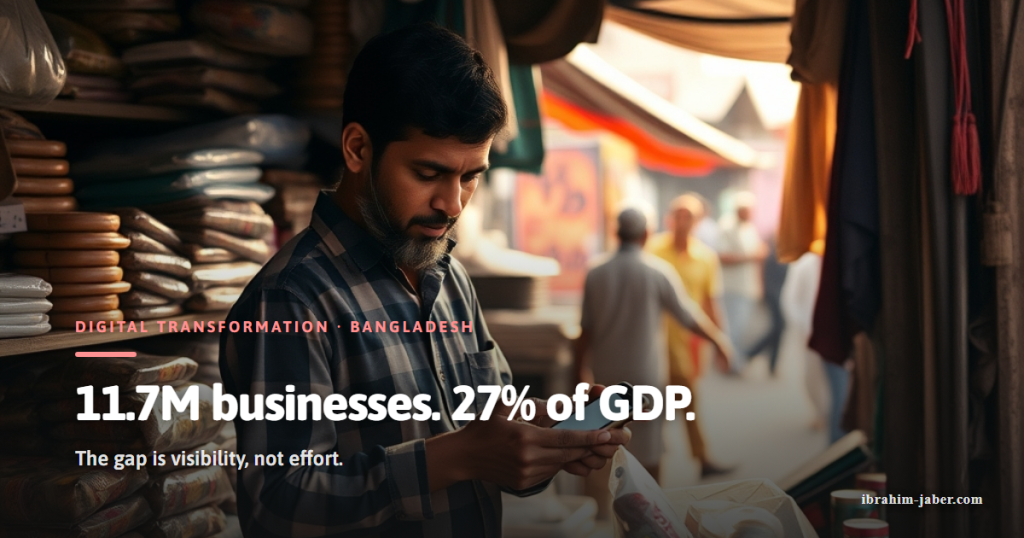
Bangladesh has 11.7 million small and medium enterprises. They generate about 27 percent of GDP. Vietnam has more than 13 times fewer SMEs, and theirs produce roughly 50 percent of GDP. That single comparison is the clearest argument for digital transformation in Bangladesh that I know of, and it has almost nothing to do with how hard anyone is working.
The gap is structural. Bangladeshi businesses are not less ambitious. They are less visible: to lenders, to customers, to supply chains, and to the data systems that decide where capital goes. Digital transformation is how a business becomes visible.
Connectivity in Bangladesh collapses the moment you move from SIM cards to actual internet use, and collapses again when you leave the city. There were 185 million active cellular connections at the start of 2025, equal to 106 percent of the population, because people hold multiple SIMs. Yet only 77.7 million people, 44.5 percent, used the internet at all. In rural areas, where 63.11 percent of the country's SMEs are located, internet access sits below 38 percent.
This matters because most digital strategy in Bangladesh is built for the 44.5 percent and priced for the 106 percent. A business that assumes its rural customers can load a heavy JavaScript storefront on a 3G connection has not digitised. It has simply moved its exclusion online.
According to DataReportal's Digital 2025 report for Bangladesh, the country recorded 77.7 million internet users in January 2025, a penetration rate of 44.5 percent, alongside 60.0 million social media identities (34.3 percent of the population) and 185 million cellular connections. Internet users grew by 939,000 year on year, a rate that leaves more than half the population offline.
Bangladesh's SME sector is enormous in headcount and small in output, and the difference is measurable. Of 11.7 million SMEs, only 3.28 million (28 percent) are formal. The remaining 7.55 million, 64.59 percent, operate informally. An informal business cannot easily open a merchant account, build a credit history, appear in a supplier database, or accept digital payments at scale. It is economically invisible.
New Age reported in June 2026 that Bangladesh's 11.7 million SMEs contribute roughly 27 percent of GDP and 80 percent of non-agricultural employment, citing Bangladesh Bureau of Statistics 2024 figures. The same reporting notes an MSME financing gap of $2.8 billion estimated by the International Finance Corporation, attributing the shortfall to the absence of reliable data systems linking businesses to finance and markets.
Read that last clause again, because it is the whole thesis: the shortfall is a data problem before it is a money problem. Lenders are not withholding $2.8 billion out of malice. They are withholding it because 7.55 million businesses produce no legible record of what they sell, to whom, or how reliably they get paid.
The most expensive mistake I see is treating digital transformation as a procurement item: buy a website, buy a Facebook page, declare victory. Transformation is the act of turning business activity into data that other systems can read. A website is one possible output of that. It is not the thing itself.
Concretely, a transformed business has three properties a non-transformed one lacks:
Most Bangladeshi businesses that believe they have "gone digital" have achieved only the first, and often not even that: a storefront that takes eleven seconds to load on a rural 3G connection is not findable in any sense that matters.
Research on Bangladeshi SMEs converges on the same three barriers: cost, skills, and infrastructure. They are not equally tractable, and they do not deserve equal attention.
The infrastructure gap is real but largely outside any single business's control. Rural internet access below 38 percent is a national problem, not a firm-level one. What is in a firm's control is designing for the connection its customers actually have, rather than the one its developer has.
The skills gap is the most cited and the most misdiagnosed. The shortage is rarely in people who can build things. Bangladesh has roughly 650,000 registered freelancers and ranks second globally in online labour supply by the Oxford Internet Institute's measure. The shortage is in people who can decide what to build and prove whether it worked.
The trust gap is the quiet one. Mobile payment adoption among SMEs remains limited, and the research attributes this to trust and technical confidence rather than access. You cannot solve a trust problem with a feature.
I build the systems that make a business legible: automated workflows, dashboards that tell the truth, and web infrastructure that performs on the connections Bangladeshi customers actually use. My work sits on the practical side of transformation, which is turning daily business activity into data, and then into decisions.
Over the past decade I have delivered more than 15 systems across 60-plus consultations for 25-plus clients, almost all of them SMEs trying to escape the same trap: a team fighting spreadsheets instead of growing. My work covers three connected areas.
What I do not do is sell transformation as a package. I would rather map your process, find the one bottleneck that is measurably costing you money, fix it, show you the number moved, and then talk about what comes next. You can see examples of that work in my portfolio.
If you run a business in Bangladesh and you are not sure whether your digital presence is working or merely existing, that is exactly the question a process audit answers. Get in touch and we can look at the evidence together.
Because the gap between business count and economic output is unusually wide. Bangladesh has 11.7 million SMEs producing about 27 percent of GDP, while Vietnam's much smaller SME base produces roughly 50 percent. Digitisation is the most direct lever available for closing that productivity gap without adding a single new business.
It is good enough to start and not good enough to ignore. Internet penetration reached 44.5 percent in January 2025 per DataReportal, while rural access remains below 38 percent. The practical implication is that businesses must build for slow, mobile-first connections rather than assuming urban broadband.
Informality. About 64.6 percent of Bangladeshi SMEs operate informally, which blocks access to formal credit and digital financial services. Digitising transactions is what makes a business legible to lenders, and legibility is the precondition for financing.
Often not. Transformation means turning your business activity into data other systems can read: digital payments, structured records, measurable customer journeys. A website is one output. Many businesses get more value from automating a broken internal workflow than from replacing the site they already have.
Start with a process audit rather than a purchase. Map where manual effort actually goes each week, find the step that costs the most time or causes the most errors, and automate that one thing first. A single automated workflow that produces clean data is worth more than a redesign that produces none.
Written by Mohammad Ibrahim Jaber, Digital Transformation Consultant based in Dhaka, Bangladesh. He helps SMEs turn broken workflows into systems that scale through AI automation, business intelligence, and web development. Connect on LinkedIn.
You must be logged in to post a comment.
